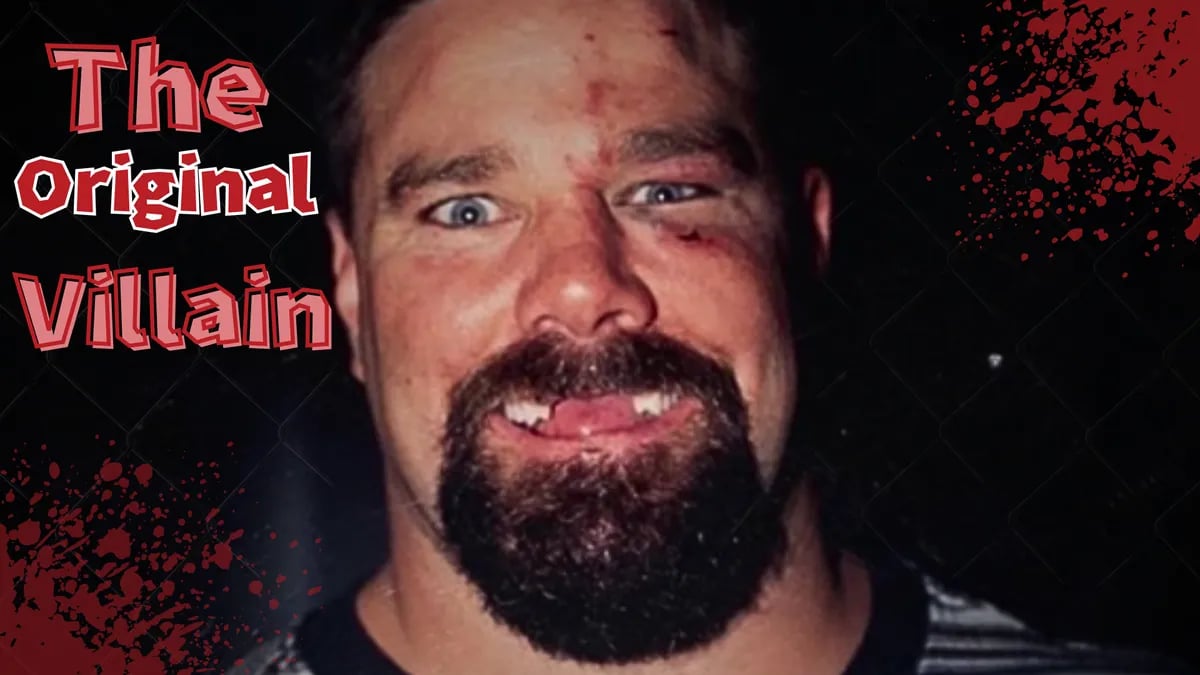
Tank Abbott: The Original MMA Villain
Before heel turns became common, Tank Abbott was terrifying opponents and audiences alike. The story of the man who made MMA dangerous.
John Brooke
February 13, 2026
The UFC has had no shortage of bad guys. Tito Ortiz turned the heel role into a brand. Conor McGregor turned it into a billion dollar empire. Colby Covington turned it into a full time job. But before any of them figured out that being hated could be profitable, there was a 270 pound bar brawler from Huntington Beach who showed up to the Octagon with a beer gut, a death wish, and one of the most terrifying right hands in combat sports history. His name was David Lee Abbott. The world knew him as Tank. And for a brief, violent stretch in the mid-1990s, he was the most dangerous and most despised man in the UFC.
Tank Abbott didn't come from a martial arts lineage. He didn't have a team of coaches refining his technique. He came from street fights, biker pits, and bar brawls and he brought every ounce of that chaos into the cage with him. He mocked unconscious opponents. He openly trashed martial arts. He bragged about sending 90 percent of his opponents to the hospital. And somehow, in the middle of all that carnage, he became one of the most important figures in early MMA history.
The Wrestler Nobody Talks About
Here's the part of Tank Abbott's story that almost nobody knows. Before he was a bar brawler, he was a wrestler.
Born on April 26, 1965, in Huntington Beach, California, David Abbott started amateur wrestling at nine years old. He continued through high school at Marina High, where he also played football, and then wrestled in college earning NJCAA All American honors at the junior college level. The guy had legitimate grappling credentials. He later transferred to California State University, Long Beach, where he earned a bachelor's degree in history.
That's right the man famous for knocking people unconscious in bar parking lots has a college degree in history. Tank Abbott is probably the only UFC fighter who could beat you senseless and then lecture you about the fall of the Roman Empire.
During his time at CSULB, Tank picked up boxing training under Noe Cruz at the Westminster Boxing Gym the same coach who trained world champion Carlos Palomino. So the "untrained street fighter" narrative that the early UFC loved to promote? It was always a bit of a myth. Tank had real wrestling, real boxing fundamentals, and a reported bench press of over 600 pounds. He wasn't just a brawler. He was a brawler with actual tools.
But it was the street fighting that made him famous. Huntington Beach in the late '80s and early '90s was a rough place, and Abbott made a name for himself in the local bar scene and in something called "pit fighting" bare knuckle brawls organized by outlaw biker gangs where two guys would jump into a dug out pit and fight until someone couldn't continue. His future manager, Dave Thomas, described Tank's style as exactly that, "pit fighting." By the time Tank walked into the UFC, he carried an undefeated record of 8-0 with 8 knockouts in those unsanctioned scraps.
The only thing Tank was missing was a stage. And in 1995, the UFC gave him one.
How a Jail Cell Led to UFC 6
Tank Abbott's path to the Octagon started, fittingly, from behind bars. He was serving a six month sentence for assault and battery when a friend approached him about fighting in the UFC. Tank had already been watching he'd been inspired by Kimo Leopoldo's wild performance at UFC 3 and had tried to get into the promotion as early as September 1994. But the UFC's management, reportedly under pressure from the Gracie family, had kept wrestlers out of the early events to protect Royce Gracie's dominance. Art Davie later confirmed that the Gracies used their influence to limit the participation of wrestlers like Abbott.
Once Royce stopped competing, that door opened. Tank's manager pitched him to UFC management as a veteran street fighter who could bench press 600 pounds and had knocked out four men in his most recent fight. The UFC loved the angle. They gave David Abbott the nickname "Tank" borrowed from the character "Tank Murdock" in the 1978 Clint Eastwood film Every Which Way But Loose billed his style as "pit fighting," and claimed he'd been in over 200 street fights.
Some of that was marketing. But enough of it was true to be terrifying.
UFC 6: The Night Tank Abbott Became a Legend
July 14, 1995. Casper Events Center, Wyoming. UFC 6. The night that changed everything.
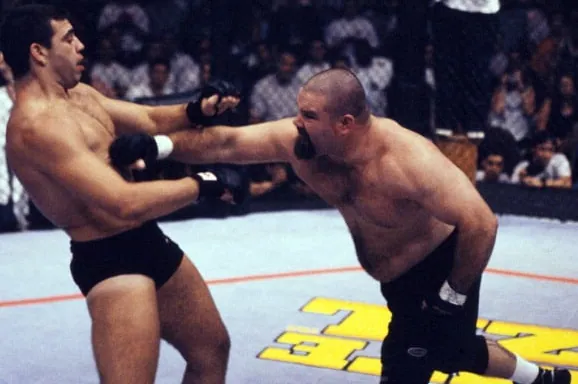
Tank Abbott made his debut against John Matua a 6'2", 400-pound Hawaiian fighter who practiced Kapu Kuialua, an ancient Polynesian martial art sometimes described as "the art of bone breaking." Matua was massive, athletic for his size, and his camp was confident that Tank was going to be a minor speed bump on the way to a tournament victory.
It lasted 18 seconds.
Tank came out with his hands low, looking almost bored like he was sizing up some loudmouth at last call on a Saturday night. He threw a right hand that clipped Matua, then another that landed flush. Matua dropped. His head bounced off the canvas. He went completely stiff arms and legs rigid, body convulsing. Ring doctors sprinted into the cage. For a moment, it looked like Matua might actually be dead.
And then Tank Abbott did something that would define his entire legacy: he turned around, looked at the convulsing Matua, raised his hands, and mocked the seizure. He imitated the convulsions while the crowd erupted. It was cruel, it was shocking, and it was arguably the single moment that put the early UFC on the map for better and for worse.
That knockout is widely cited as one of the incidents that spurred Senator John McCain's campaign to ban the UFC, calling it "human cockfighting." But it also made Tank Abbott an instant star. Love him or hate him, you were watching.
Twenty minutes later, Tank was back in the Octagon for the tournament semifinal against Paul "Polar Bear" Varelans a 6'8", 300-pound fighter from Alaska. Tank knocked him out too, finishing with brutal ground-and-pound and knees while smiling down at his beaten opponent.
In the tournament final, Tank faced Russian sambo expert Oleg Taktarov in what the announcers called "skill vs. power." After 17 minutes of war, Taktarov dragged Tank to the ground and locked in a rear-naked choke. Tank tapped. His cardio always his biggest weakness had finally caught up to him.
Three fights in one night. Two devastating knockouts. One of the most infamous moments in MMA history. And a career trajectory that, for a brief window, made Tank Abbott the most talked-about fighter on the planet.
The Tournament Era: Almost Champion, Never Quite
Tank became a fixture in the UFC's tournament format throughout the mid-'90s, and he holds the record for the most tournament appearances in UFC history with five.
At the Ultimate Ultimate 1995 a "best of the best" event featuring past tournament standouts Tank knocked out former UFC champion Steve Jennum in the first round before losing to Dan Severn in a grueling semifinal that went nearly 20 minutes. At UFC 11, he battled Scott Ferrozzo in one of the bloodiest fights of the era, losing a decision after the two men beat each other senseless for the better part of half an hour. At Ultimate Ultimate 1996, Tank stormed through Cal Worsham and Steve Nelmark before losing to Don Frye in the final via rear-naked choke.
The pattern was always the same: explosive knockouts early, followed by a wall of fatigue that better conditioned fighters could exploit. Tank's gas tank ironically was his fatal flaw. If he didn't finish you in the first few minutes, you had a very real chance of surviving the storm.
Still, the UFC wanted him in the title picture. At UFC 15 in October 1997, Tank challenged Maurice Smith for the UFC Heavyweight Championship on just four days' notice. He later described the situation as "literally falling off the barstool into the Octagon." He actually dropped Smith early with a shot that stunned the kickboxing champion, but Smith recovered, used leg kicks and movement to drain Tank's energy, and cruised to a decision victory. It was Tank's only shot at UFC gold. He never got another one.
The Personality: Why Tank Mattered Beyond the Cage
Tank Abbott understood something that most fighters in the 1990s didn't. People tune in for characters, not just techniques.
He openly mocked martial arts in interviews. He bragged about bar fights. He talked about sending opponents to the hospital like it was a personal achievement. He showed zero respect for traditional fighting disciplines and made it clear that he thought most martial artists were full of it. In an era when the UFC was still figuring out how to sell itself, Tank gave them a readymade villain a walking, talking wrecking ball who made casual fans lean forward in their seats because they either wanted to see him destroy someone or get destroyed himself.
His personality was so magnetic that Hollywood came calling. In 1997, Tank appeared on Friends as himself in the episode "The One With The Ultimate Fighting Champion," where he beat up a guy who was dating Monica. It was one of the first times the UFC crossed over into mainstream pop culture, and it happened because Tank Abbott was simply too entertaining to ignore.
He also did a stunt in WCW professional wrestling from 1999 to 2001, though that ended poorly reportedly because Tank went off script during a live pay-per-view and the promotion couldn't trust him. Which, if you know anything about Tank Abbott, should surprise absolutely nobody.
He was the first fighter to regularly wear what would become traditional MMA gloves in the UFC. He coined the "pit fighting" label that still gets referenced today. And he mentored a young college wrestler named Tito Ortiz training him at Cal State Bakersfield and eventually helping him get his first UFC fight. The original MMA villain literally helped create the next one.
The Decline and the Comebacks That Kept Coming
As MMA evolved in the late '90s and early 2000s, Tank didn't evolve with it. The sport moved toward well-rounded fighters guys who could wrestle, strike, and submit. Tank could wrestle and punch. That was it. And the punching only worked if you stood in front of him.
At UFC Brazil in October 1998, Pedro Rizzo became the first man to knock Tank out a milestone that signaled the sport had officially outgrown him. His final stretch in the UFC was rough. He returned at UFC 41 in February 2003 and lost to Frank Mir via toe hold in under a minute. Losses to Kimo Leopoldo and Wesley "Cabbage" Correira followed, and the UFC released him.
But Tank kept fighting. He bounced through Strikeforce (KO loss to Paul Buentello in 43 seconds), Pride (submission loss to judo legend Hidehiko Yoshida), and EliteXC (KO loss to Kimbo Slice in a fight marred by controversy). His record ballooned on the wrong side of the ledger. By the end of his career, Tank had more losses than wins making him, as one outlet noted, the most famous fighter in MMA history with a losing record.
His final MMA bout came in 2013 at a King of the Cage event, where he lost to Ruben Villareal via second-round TKO. He was 48 years old and still swinging.
The Hardest Fight: Life After the Cage
In December 2018, Tank Abbott revealed that years of hard living had caught up to him. His liver was failing and needed to be replaced. The transplant surgery at Cedars Sinai hospital in Beverly Hills nearly killed him and that's not an exaggeration.
Tank suffered multiple strokes on the operating table. By his own account, he flatlined five times during the procedure. He spent 107 days in the intensive care unit. When he finally recovered, he'd lost over 100 pounds from his fighting weight.
"This is the hardest fight I've ever had," Tank said after the surgery. Coming from a man who once fought three times in a single night against opponents who outweighed him by over a hundred pounds, that statement carries serious weight.
Tank survived. He recovered. And in typical Tank fashion, he started celebrating his "Liverversary" on social media every year, treating the anniversary of the transplant as a second birthday. He also launched a podcast called The Proving Ground with Tank Abbott and authored a trilogy of novels Bar Brawler, Street Warrior, and Cage Fighter under the series title "Befor There Were Rules." Yes, that's how it's spelled. No, we're not going to question it. This is Tank Abbott. Grammar was never the weapon of choice.
The Record and the Legacy
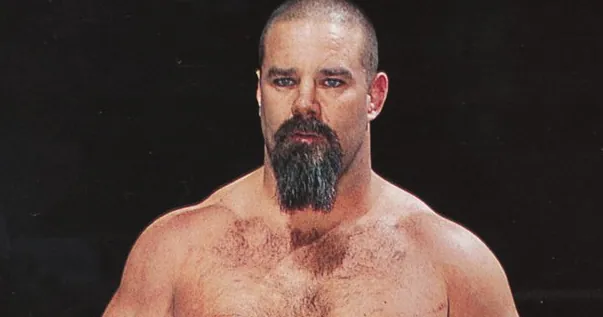
Tank Abbott's professional MMA record doesn't scream "legend." He finished with more losses than wins, never captured a championship, and was finished multiple times by fighters who simply had better conditioning and more complete skill sets.
But the thing is Tank Abbott's legacy has almost nothing to do with his record.
He was one of the first fighters to prove that raw knockout power could compete with trained martial artists and he did it during an era when the sport had no weight classes, no time limits, and very few rules. His knockout of John Matua at UFC 6 is still one of the most replayed moments in UFC history nearly 30 years later. His personality helped the UFC cross over from underground spectacle to mainstream entertainment. He trained Tito Ortiz, who went on to become one of the most important fighters the promotion has ever had. And he set the template for the "just bleed" fan favorite the guy who shows up to fight, not to game plan.
Every knockout artist who's ever gotten a crowd on their feet owes a small debt to Tank Abbott. He wasn't the most skilled. He wasn't the most disciplined. He definitely wasn't the most well conditioned. But he was the first guy to walk into the Octagon, look at a 400-pound man, and swing for the fences like he had nothing to lose because honestly, he didn't.
The original MMA villain. The Huntington Beach bar brawler who stumbled off a barstool and into sports history. That's Tank Abbott. And nobody's going to forget him anytime soon.
This is CageLore stay locked in.
Frequently Asked Questions
What is Tank Abbott's real name?
Tank Abbott's real name is David Lee Abbott. The UFC gave him the nickname "Tank" before his debut at UFC 6 in 1995, borrowing it from the character "Tank Murdock" in the 1978 Clint Eastwood film Every Which Way But Loose. He was billed as a "pit fighter" from Huntington Beach, California.
What is Tank Abbott's MMA record?
Tank Abbott's professional MMA record features more losses than wins across promotions including the UFC, Pride, Strikeforce, EliteXC, and King of the Cage. Despite the losing record, he remains one of the most recognized and influential figures in early MMA history. He holds the UFC record for most career tournament appearances with five.
What happened with Tank Abbott and John Matua at UFC 6?
Tank knocked out the 400-pound Matua in just 18 seconds at UFC 6 in July 1995. The knockout left Matua convulsing on the canvas, and Abbott infamously mocked his opponent's seizure while doctors rushed to attend to him. The moment is considered one of the most controversial in UFC history and is widely cited as a catalyst for Senator John McCain's campaign against the sport.
Did Tank Abbott ever fight for a UFC championship?
Yes. Tank challenged Maurice Smith for the UFC Heavyweight Championship at UFC 15 in October 1997, stepping in on just four days' notice. He dropped Smith early but ran out of gas, losing the fight by decision. It was his only title shot in the UFC.
Did Tank Abbott train Tito Ortiz?
Yes. Tank and Tito Ortiz were training partners at Cal State Bakersfield in the mid-1990s. Abbott helped Ortiz get his start in MMA, and Ortiz made his UFC debut at UFC 13 in 1997 — the same event where Tank fought Vitor Belfort. Ortiz went on to become UFC Light Heavyweight Champion and one of the biggest stars in the promotion's history.
Is Tank Abbott still alive?
Yes. Tank underwent a life-saving liver transplant in 2018 at Cedars-Sinai hospital, during which he suffered multiple strokes and flatlined several times. He spent 107 days in the ICU but recovered. He now hosts a podcast called The Proving Ground with Tank Abbott.
Related Articles
Uros Medic Headlines Serbia's First UFC Event
Uros Medic asked to headline Serbia's first ever UFC event instead of chasing a title shot. The story of his grind from Novi Sad to Alaska to the UFC, and the homecoming Saturday.
Abdul Hussein: Refugee Camp to UFC Debut Win
The best story on the UFC Abu Dhabi card was the first fight of the night. Abdul Hussein's road from a refugee camp to a debut win, and the ten year wait in between.
Joshua Van: From a Refugee Camp to UFC Champion
Joshua Van fled a war in Myanmar, spent two years in a refugee camp, and learned to fight on YouTube. Now he's UFC flyweight champ, and Pantoja wants a rematch to settle it.