
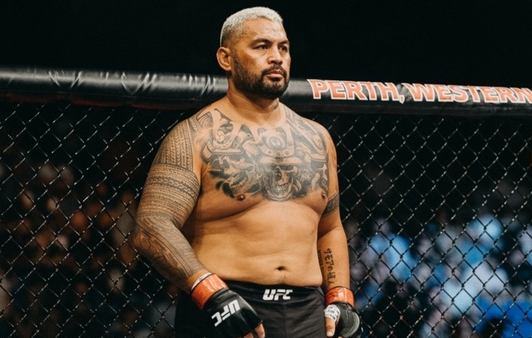
From South Auckland Streets to the K-1 World Grand Prix: The Origin of Mark Hunt
Beaten as a child. In prison twice by 18. Then a nightclub brawl changed everything.
John Brooke
March 4, 2026
Most fighters say the cage saved their life. For Mark Hunt, that's not a metaphor it's a literal, documented fact. Before he was the "Super Samoan," before the walk-off knockouts that made him a UFC fan favorite, before he won the biggest prize in kickboxing history, Mark Hunt was a kid in South Auckland getting beaten with broomsticks and apple branches by a father so sadistic he'd hang his own children from hooks in the garage.
This isn't your typical underdog story. This is the story of a man who came from a level of darkness most people can't even comprehend and punched his way out of it with two fists and an iron chin that refused to break.
A Childhood That Should Have Destroyed Him
Mark Richard Hunt was born on March 23, 1974, in South Auckland, New Zealand, into a large Samoan Mormon family. On paper, that sounds like a foundation for a solid upbringing. In reality, the Hunt household was a horror show.
Hunt's father, Charles, was a sadistic abuser who terrorized his children physically, mentally, and emotionally. In his 2015 autobiography Born to Fight, Hunt described being hog tied and whipped with apple tree branches until the skin peeled off his back. He was hung from a hook in the family garage and beaten with a broom handle. If one kid tried to escape the punishment, the others were beaten worse so his own brothers would chase him down and drag him back.
"My old man was ruthless," Hunt said. "He terrorized us. He'd start with the mental games before he even found the implements to hit us with."
But Mark wasn't the one who suffered most. His older sister Victoria endured the worst abuse in the household, subjected to horrific crimes by their father from the age of six until she left home at eighteen. Victoria later recalled that she "mothered" Mark through the violence, washing away blood, massaging his bruises, and putting salt on his wounds so their father could beat him again the next day.
Their mother knew. The local church knew. Nobody did anything.
Street Fighting, Bullying, and Two Trips to Prison
With no model for normal human behavior, Hunt became exactly what his environment built. A violent, angry kid with no fear and no understanding of consequences. He bullied other children, he stole, he fought anyone who looked at him wrong. By his own admission, he was "a cheap criminal" who did "many, many wrongs."
"I felt safer on the streets than I did at home," Hunt said. "The scrapping was my way of dealing with the anger I felt towards my parents."
That anger landed him in prison, twice. Both times for violent offenses. Hunt was still a teenager navigating a world that had taught him nothing except that pain was constant and strength was the only currency that mattered.
By the time he got out of jail the second time, Mark Hunt was on a direct path to spending the rest of his life locked up. He had no education, no job, no prospects. Just a pair of fists and a rage that had nowhere constructive to go.
Then one night outside an Auckland nightclub changed everything.
The Brawl That Started a Career
Fresh out of prison for the second time, Hunt found himself outside a nightclub called "Don't Tell Mama" in Auckland. A fight broke out the details are hazy, the result is not. Hunt knocked out multiple people in rapid succession. It wasn't close. It wasn't a lucky shot. It was a display of raw, terrifying power that stopped the entire street.
A bouncer named Sam Marsters saw it happen. Instead of calling the cops, Marsters yanked Hunt inside the club and hid him in the staff toilets while the police presence died down. Then he made Hunt an offer that would change his life. Come train at my gym. Have a real fight.
Within a week, Hunt had his first Muay Thai kickboxing bout. He won by first round knockout. His trainer gave him a case of beer as a bonus.
Mark Hunt had no interest in being a professional fighter. He had no background in martial arts, no amateur wrestling career, no combat sports pedigree whatsoever. He was a street brawler from South Auckland who hit people harder than anyone Sam Marsters had ever seen. And that was enough to start.
From Stepping Stone to K-1 World Champion
Hunt eventually moved to Sydney, Australia, where he trained under Alex Tui and later settled at Liverpool Kickboxing Gym under Maori instructor Hape Ngaranoa. In these early years, promoters used Hunt as cannon fodder a tough, durable body they could throw at their prospects to make them look good. He took fights on short notice and nobody expected him to win.
He kept winning anyway. Hunt compiled a 15-4 record on the Oceanian kickboxing circuit while barely taking the sport seriously. Then in February 2000, promoter Tarik Solak put together a K-1 Oceania tournament, and Hunt a massive underdog knocked out every opponent he faced to win the title. He won it again in 2001.
Those regional titles earned Hunt an invitation to Japan for K-1, the absolute pinnacle of heavyweight kickboxing. The K-1 World Grand Prix was where legends like Ernesto Hoost, Peter Aerts, and Jérôme Le Banner competed in front of 65,000 fans at the Tokyo Dome. Hunt was nobody on that stage.
Here's where the story gets insane.
At the 2001 K-1 World Grand Prix, Hunt lost a decision to defending champion Ernesto Hoost. His tournament should have been over. But when Mirko Cro Cop pulled out with an injury, Hunt was given a wildcard spot in the repechage. He fought Ray Sefo in one of the most violent exchanges in K-1 history both men dropping their hands and trading bombs. Hunt lost the decision, but when Sefo's eye swelled shut and he couldn't continue, Hunt took his spot.
From there, Hunt knocked out Adam Watt to qualify for the finals at the Tokyo Dome. When it came time to pick his quarterfinal opponent, Hunt chose Jérôme Le Banner the same man who had beaten him the year before. Revenge was served via second-round knockout.
Hunt then beat Stefan Leko by unanimous decision in the semis. In the final against Brazilian karate champion Francisco Filho, Hunt worked the body relentlessly landing 15 body shots in the extra round alone to claim a unanimous decision and the 2001 K-1 World Grand Prix Championship.
A kid from South Auckland who'd been in prison twice and had zero martial arts training four years earlier was now the heavyweight kickboxing champion of the world.
The payout: $400,000. The significance: immeasurable.
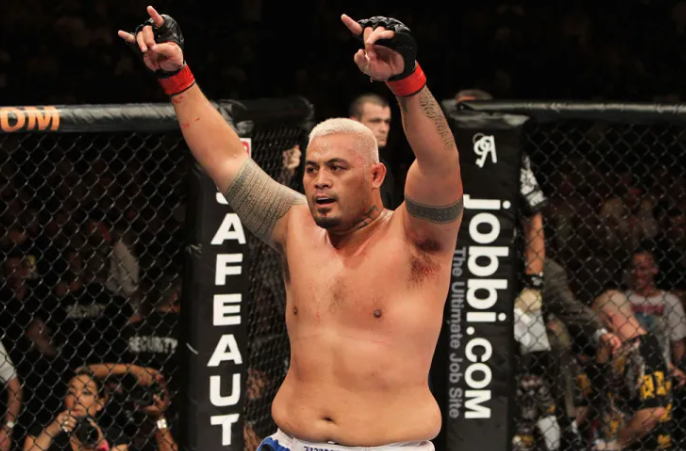
Transition to MMA: Pride, the UFC, and the Walk-Off King
After defending his K-1 title in a brutal loss to Le Banner in Paris (Hunt's corner threw in the towel after he was knocked down twice in the second round), Hunt transitioned to mixed martial arts in 2004 through Japan's Pride Fighting Championships the most stacked heavyweight division on the planet at the time.
His first MMA fight was a submission loss to Olympic judo gold medalist Hidehiko Yoshida. Not exactly a soft landing. But Hunt's power translated immediately. He beat Dan Bobish by TKO, upset reigning Pride middleweight champion Wanderlei Silva by split decision as a late replacement, and then pulled off one of the biggest upsets in Pride history by beating Mirko Cro Cop the same man who'd hurt him in K-1 by split decision at Pride Shockwave 2005.
Hunt's Pride run ended with losses to Josh Barnett and Fedor Emelianenko (he actually had Fedor in an Americana before getting kimura'd), and after the UFC purchased Pride in 2007, Hunt's contract came with the deal.
Dana White famously offered Hunt $400,000 just to go away. Hunt had lost five straight fights. The UFC didn't want him. But Hunt refused the buyout and demanded the promotion honor his contract and let him fight. It was the most Mark Hunt move imaginable stubborn, proud, and completely unwilling to quit.
The UFC Run: Walk-Offs and War Stories
Hunt's UFC debut was a disaster submitted by Sean McCorkle in the first round. But then the Super Samoan found his groove and became one of the most beloved heavyweights in UFC history.
The walk-off KO became his signature. Hunt would land a bomb so devastating he'd simply turn around and walk away before the referee even stopped the fight. He knew it was over. It was always over.
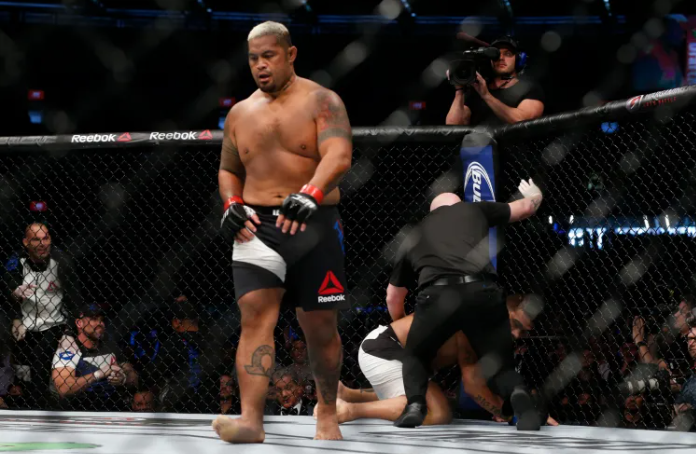
Chris Tuchscherer at UFC 127 — walk-off knockout. Knockout of the Night.
Cheick Kongo at UFC 144 — stopped a four-fight unbeaten streak with pure power.
Stefan Struve at UFC on Fuel TV 8 — a 5'10" man knocked out a 7'0" man so hard it broke his jaw. Walk-off. Knockout of the Night.
Roy Nelson at UFC Fight Night 52 — the man who'd never been stopped? Hunt sent him face-first into the canvas with an overhand right. Walk-off.
Frank Mir at UFC Fight Night 85 — another first-round walk-off knockout. Mir later said Hunt hit harder than anyone he'd ever faced. Performance of the Night.
And then there was the five-round war with Antonio "Bigfoot" Silva at UFC Fight Night 33 in December 2013 widely considered one of the greatest heavyweight fights in UFC history. Both men nearly finished each other multiple times. Hunt came back from a first-round knockdown to batter Silva's face beyond recognition. The fight ended in a draw, earned Fight of the Night, and cemented Hunt as a fan favorite forever. (Silva later tested positive for elevated testosterone, making the whole thing even more infuriating for Hunt.)
At his peak, Hunt fought Fabricio Werdum for the interim UFC Heavyweight Championship at UFC 180 in November 2014. He lost by TKO in the second round the closest the Super Samoan ever got to UFC gold.
The Brock Lesnar Saga and the War on PEDs
Hunt's legacy extends beyond his fists. He became combat sports' loudest voice against performance enhancing drugs and he paid a massive price for it.
At UFC 200 in July 2016, Hunt faced a returning Brock Lesnar, who hadn't fought in nearly five years. The UFC waived the standard four month USADA testing window to fast track Lesnar's comeback. Lesnar won by unanimous decision, earning $2.5 million. Hunt made $700,000.
Six days later, it was revealed Lesnar had failed a pre-fight drug test for clomiphene, an anti-estrogen agent commonly associated with steroid use. The result was overturned to a no contest. Lesnar was fined $250,000 ten percent of his purse and suspended for one year.
Hunt was livid. He demanded Lesnar's entire purse. When the UFC declined, he filed a RICO lawsuit in 2017 against the UFC, Dana White, and Lesnar, alleging they knowingly allowed a doped fighter to compete against him. The lawsuit dragged on for years. Hunt eventually had to represent himself after his lawyers withdrew. In 2023, a federal judge ruled against him. His 2025 appeal was also denied. He was ordered to pay over $375,000 in the UFC's legal fees.
Hunt lost the legal battle. But he forced a conversation about fighter safety and PED accountability that the UFC had been trying to avoid for years. Right or wrong on the legal merits, nobody can question Mark Hunt's conviction.
"I will probably end my life fighting," Hunt once wrote. "I just hope that if it does happen, it will be in an honest and fair competition."
The Record and the Reality
Mark Hunt's MMA record reads 13-14-1 with 1 no contest. His kickboxing record is approximately 30-13. On paper, that's a losing record in MMA. In reality, that record is one of the most misleading numbers.
Hunt's MMA opponents include Fedor Emelianenko, Mirko Cro Cop, Wanderlei Silva, Junior dos Santos, Fabricio Werdum, Stipe Miocic, Alistair Overeem, Brock Lesnar, and Derrick Lewis. He fought almost exclusively top 10 or top 15 heavyweights for the entirety of his UFC career. His losses came against champions and title challengers. His wins came via some of the most spectacular knockouts the sport has ever seen.
Nine KO/TKO wins in MMA. Four signature walk off knockouts in the UFC. Two Knockout of the Night bonuses. Three Fight of the Night bonuses. Two Performance of the Night bonuses. The K-1 World Grand Prix Championship.
And all of it without a single day of formal martial arts training before the age of 23.
Life After Fighting: The Man Behind the Fists
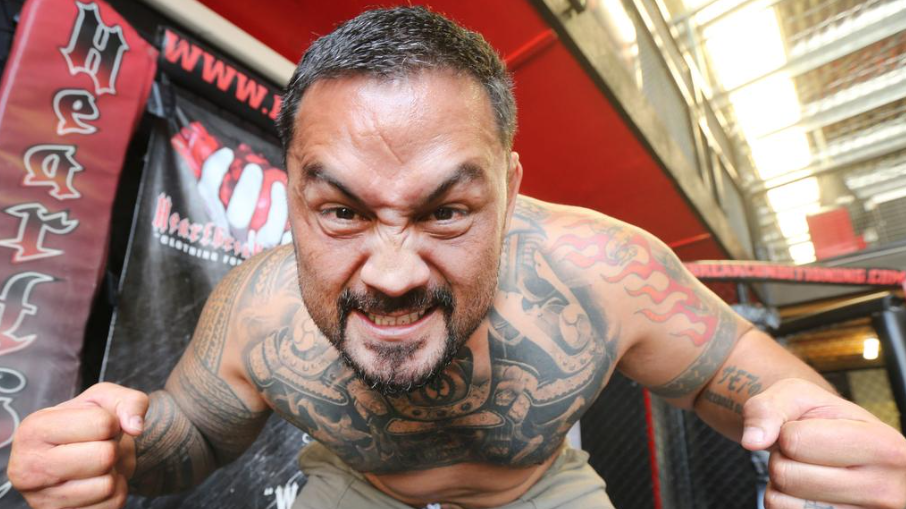
Hunt's last UFC fight came at UFC Fight Night 142 in December 2018 a decision loss to Justin Willis. He competed in a professional boxing match against Sonny Bill Williams in late 2022, scoring a knockout victory.
Away from fighting, Hunt's greatest victory has been personal. His wife Julie the woman he met at a reggae club in 1994 gave him an ultimatum. Get therapy or she was leaving. Hunt chose therapy. It changed his life.
"Don't get me wrong, Mark still has some problems," Julie said. "But he's mentally strong and he has come out of that family the most normal. I'm proud of what Mark has become today. He's not like his father."
Hunt's brother John died by suicide. His brother Steve was diagnosed with schizophrenia and lives with their sister Victoria. Their father died of pancreatic cancer in 2005. Mark is the one who made it out and he's spent his post-fighting years coaching young athletes, raising his children, and living the kind of stable, loving life that was never an option when he was growing up.
He wrote Born to Fight not for fame or money, but because his publisher told him his story might help others who were trapped in dark places. That's the Mark Hunt legacy that matters more than any knockout.
Thanks for riding with CageLore. Stay locked in!
FAQ
What is Mark Hunt's real name?
Mark Richard Hunt, born March 23, 1974, in South Auckland, New Zealand. He is of Samoan descent and is commonly known by his nickname "The Super Samoan."
What is Mark Hunt's MMA record?
Hunt's professional MMA record is 13-14-1 with 1 no contest. Despite the losing record, Hunt fought almost exclusively top-tier heavyweights across Pride FC and the UFC and earned seven post-fight bonuses in the UFC alone.
Why is Mark Hunt called the "King of Walk-Offs"?
Hunt earned this nickname for his signature move of landing a knockout blow and immediately walking away before the referee officially stopped the fight. He recorded four walk off knockouts in the UFC against Chris Tuchscherer, Stefan Struve, Roy Nelson, and Frank Mir.
Did Mark Hunt win the K-1 World Grand Prix?
Yes. Hunt won the 2001 K-1 World Grand Prix on December 8, 2001, at the Tokyo Dome in front of 65,000 fans. He knocked out Jérôme Le Banner in the quarterfinals, beat Stefan Leko by decision in the semis, and defeated Francisco Filho by unanimous decision in the final.
What happened between Mark Hunt and Brock Lesnar at UFC 200?
Lesnar defeated Hunt by unanimous decision at UFC 200 in July 2016, but six days later it was revealed Lesnar had failed a pre-fight drug test for clomiphene. The result was overturned to a no-contest. Hunt filed a RICO lawsuit against the UFC, Dana White, and Lesnar in 2017, but the case was ultimately dismissed.
Is Mark Hunt still fighting?
Hunt's last MMA fight was at UFC Fight Night 142 in December 2018. His most recent combat sports appearance was a boxing match against Sonny Bill Williams in late 2022, which Hunt won by knockout. He is now retired from professional fighting and works as an MMA and jiu-jitsu coach.
Related Articles
Michael 'Venom' Page Just Got Booed in His Own Country and Still Climbed the Rankings. His Story Is Way Crazier Than You Think
Michael 'Venom' Page started kung fu at three, won 10 world kickboxing titles, and turned down the Olympics. Now he's 4-1 in the UFC, climbing the welterweight rankings, and getting booed in his own country.
Who Is Salahdine Parnasse? KSW Double Champ Fighting on Netflix May 16
Baisangur Susurkaev: The Chechen Who Fought Twice in One Week and Won Both
Bro, I need to tell you about this dude because what he did last August might be the craziest week any fighter has ever had in the UFC.